

Choosing the Right Legal Structure for Your Startup: LLC vs. C-Corp
Establishing the correct legal foundation is the single most critical decision a founder makes before writing a line of code or launching a marketing campaign. According to recent industry data, over 60% of new business entities formed in the United States are limited liability companies, yet venture-backed startups overwhelmingly choose C-corporations to facilitate equity financing. This divergence highlights a fundamental truth: the "best" structure is not a universal standard but a strategic tool tailored to your specific growth trajectory, tax obligations, and investor requirements. Warren Kalyan has guided thousands of clients through this exact decision matrix since 1980, ensuring that early structural choices do not become costly liabilities during future exits or audits. (Texas and New York)
Understanding Core Legal Structures
Before diving into the specifics of LLCs and C-Corps, it is essential to define what a legal structure actually represents. A business entity is a legal structure that a business operates under, determining how it is taxed, how much paperwork it is required to do, and how personal assets are protected. Entity formation is the process of legally establishing your business as a separate entity from its owners. This separation is the cornerstone of modern commerce, allowing entrepreneurs to innovate without risking their personal savings, homes, or vehicles.
The two primary contenders for startup founders are the Limited Liability Company (LLC) and the C-Corporation. While both offer liability protection, they operate on fundamentally different philosophical and mechanical principles. An LLC is a hybrid structure that blends the liability protection of a corporation with the tax benefits and operational flexibility of a partnership. In contrast, a C-Corporation is a distinct legal entity that is taxed separately from its owners, creating a clear boundary between corporate profits and personal income.
Choosing incorrectly can lead to severe consequences. Founders who form an LLC when they plan to raise venture capital often face "conversion fatigue," where they must spend thousands of dollars and months of legal time converting their entity later. Conversely, founders who form a C-Corp for a small, bootstrapped business may face unnecessary administrative burdens and double taxation. Understanding the nuances of each is vital for long-term success.
The LLC Advantage: Flexibility and Liability
The Limited Liability Company has surged in popularity because it offers a streamlined path to liability protection without the rigid formalities of a corporation. Pass-through taxation is a system where business profits are reported on the owners' personal tax returns, avoiding corporate income tax. This means the LLC itself does not pay federal income taxes. Instead, profits and losses are passed through to the members, who report them on their individual tax returns. This structure eliminates the "double taxation" issue faced by C-Corps.
For early-stage startups that do not anticipate seeking venture capital, the LLC is often the most efficient choice. It allows for flexible profit distribution. Unlike corporations, which must distribute dividends based on share ownership, an LLC can distribute profits in any manner agreed upon by the members. This is particularly useful for founders who contribute different types of value, such as one partner providing capital and another providing intellectual property.
However, the LLC has limitations when it comes to scaling. Venture capital firms and institutional investors are generally prohibited from investing directly in LLCs due to the risk of Unrelated Business Taxable Income (UBTI). If an investor is a tax-exempt entity, such as a university endowment or a pension fund, their investment in an LLC could generate taxable income for the fund, creating a compliance nightmare. This is why most high-growth startups avoid the LLC structure from day one if they plan to raise institutional capital.
The C-Corporation: The Venture Capital Standard
If your startup plans to raise money from angel investors or venture capital firms, the C-Corporation is not just a recommendation; it is a requirement. The C-Corp structure is the only entity type that can issue different classes of stock, such as common stock for founders and preferred stock for investors. Preferred stock comes with specific rights, including liquidation preferences, which protect investors in the event of a sale or bankruptcy.
Another critical factor is the issuance of stock options. Startups rely heavily on employee stock options to attract top talent. C-Corporations can easily issue Incentive Stock Options (ISOs) and Non-Qualified Stock Options (NSOs) to employees. These options are a powerful tool for aligning employee interests with the company's long-term success. While LLCs can issue "profits interests," these are often more complex to administer and less familiar to potential hires.
The primary drawback of the C-Corp is double taxation. The corporation pays taxes on its profits at the corporate level. When those profits are distributed to shareholders as dividends, the shareholders pay taxes on that income again at the individual level. However, for high-growth startups, this is rarely an immediate concern. Most startups reinvest all profits back into growth rather than distributing dividends, effectively deferring this tax liability until a liquidity event, such as an IPO or acquisition, occurs.
S-Corporation Tax Implications and Limitations
Some founders consider the S-Corporation as a middle ground. An S-Corp is not a business entity itself but a tax election made by a corporation or LLC with the IRS. It allows businesses to avoid double taxation by passing corporate income, losses, deductions, and credits through to shareholders for federal tax purposes. This can result in significant tax savings for business owners who pay themselves a reasonable salary and take the rest as distributions.
However, the S-Corp status comes with strict eligibility requirements. You cannot have more than 100 shareholders, and all shareholders must be U.S. citizens or residents. Furthermore, you can only have one class of stock. These restrictions make the S-Corp unsuitable for most startups aiming for rapid growth or foreign investment. If you plan to bring in international investors or issue multiple classes of equity, the S-Corp election will disqualify you from future financing rounds.
Additionally, the administrative burden of maintaining S-Corp status can be heavy. You must adhere to strict payroll requirements, ensuring that shareholder-employees are paid a "reasonable salary" subject to payroll taxes. The IRS scrutinizes S-Corp owners who attempt to minimize payroll taxes by taking excessive distributions. For a startup navigating complex regulatory landscapes, adding S-Corp compliance to your workload is often an unnecessary complication.
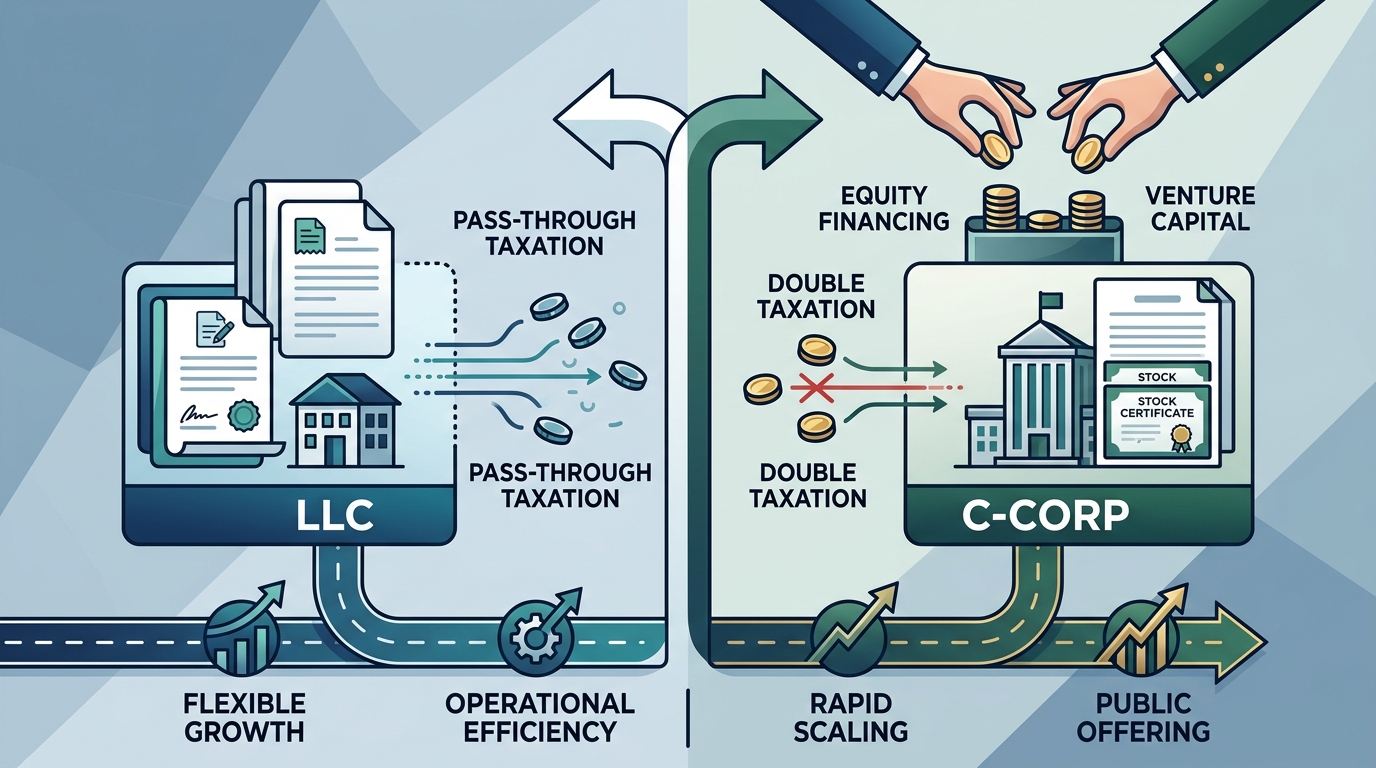
Comparing Structures for Startup Growth
To make an informed decision, you must weigh the operational, financial, and strategic implications of each structure. The following table summarizes the key differences between LLCs and C-Corporations in the context of startup development.
| Feature | LLC (Limited Liability Company) | C-Corporation |
|---|---|---|
| Taxation | Pass-through taxation (no corporate tax) | Double taxation (corporate + dividend tax) |
| Investor Readiness | Low (VCs generally avoid LLCs) | High (Standard for VC funding) |
| Stock Issuance | Membership interests (flexible) | Preferred and Common Stock (standardized) |
| Administrative Burden | Low (fewer formalities) | High (board meetings, minutes, filings) |
| Profit Distribution | Flexible (as per operating agreement) | Strict (pro-rata based on shares) |
When evaluating these factors, consider your exit strategy. If you plan to sell your company in three to five years, a C-Corp structure will make the due diligence process smoother for buyers. Buyers prefer the clean equity structure of a C-Corp over the complex operating agreements of an LLC. Furthermore, the corporate governance framework is the system of rules and practices by which a company is directed and controlled. C-Corps have a well-defined governance structure with a board of directors, officers, and shareholders, which provides clarity and accountability that investors demand.
Another critical consideration is the state of incorporation. While many startups incorporate in Delaware due to its well-established corporate law and specialized Court of Chancery, others may choose their home state for simplicity. Warren Kalyan provides expert guidance on entity formation and governance tailored to your specific jurisdiction, ensuring that your foundational documents are robust and enforceable.
Key Takeaways
- Investor Alignment: If you plan to raise venture capital, form a C-Corporation immediately to avoid costly conversions later.
- Tax Efficiency: LLCs offer pass-through taxation, which is beneficial for bootstrapped businesses that want to avoid double taxation.
- Equity Flexibility: C-Corps allow for the issuance of preferred stock, which is essential for attracting institutional investors.
- Administrative Load: LLCs require fewer formalities and meetings, making them easier to manage for small teams.
- Historical Context: Warren Kalyan has been advising businesses since 1980, with deep expertise in both Texas and New York regulatory environments.
- Exit Strategy: A C-Corp structure simplifies the acquisition process and due diligence for potential buyers.
- Compliance Risks: Incorrect classification can lead to IRS penalties, so professional advice is critical for long-term compliance.
Frequently Asked Questions
Can I convert an LLC to a C-Corp later?
Yes, you can convert an LLC to a C-Corp, but the process is complex and expensive. It involves filing new articles of incorporation, issuing stock, and potentially triggering tax events. It is far more efficient to choose the correct structure from the start.
Do I need a lawyer to form my startup?
While you can form an LLC online, a lawyer ensures your operating agreement or bylaws protect your interests. Warren Kalyan's blog provides insights into common pitfalls that founders face when DIY-ing their legal formation.
What is the difference between an S-Corp and a C-Corp?
An S-Corp is a tax election that avoids double taxation but has strict shareholder limits. A C-Corp is a standard corporate structure that allows for unlimited shareholders and preferred stock, making it ideal for fundraising.
Why do venture capitalists prefer C-Corps?
VCs prefer C-Corps because they can issue preferred stock with specific rights and avoid the tax complications associated with investing in LLCs, such as Unrelated Business Taxable Income (UBTI).
Is Delaware the best state to incorporate?
Delaware is popular due to its business-friendly laws and specialized courts, but it may not be the best choice for every startup. Factors like your home state and operational costs should be considered.
How does an LLC protect personal assets?
An LLC creates a legal barrier between the business and its owners. If the business is sued or goes into debt, creditors generally cannot seize the personal assets of the members, such as their home or car.
What are the ongoing compliance requirements for a C-Corp?
C-Corps must hold annual shareholder and board meetings, keep detailed minutes, file annual reports, and pay franchise taxes. Failure to maintain these formalities can pierce the corporate veil, exposing owners to liability.
Can foreign nationals own a C-Corp?
Yes, foreign nationals can own shares in a C-Corporation. This is not permitted for S-Corps, which require all shareholders to be U.S. citizens or residents.
Schedule Your Formation Consultation
Choosing the right legal structure is not a one-size-fits-all decision. It requires a deep understanding of your financial goals, investor profile, and long-term vision. At Warren Kalyan, we combine decades of experience in Texas and New York business law with innovative digital processes to provide clear, actionable advice. We don't just advise; we execute, from formation through exit.
Don't let structural uncertainty slow down your launch. Contact our team today to schedule a consultation and ensure your startup is built on a solid legal foundation. Whether you are in Austin or New York City, our attorneys are ready to help you navigate the complexities of business law with precision and efficiency.