

Hospitality operators face unique commercial lease challenges that standard business tenants rarely encounter. According to recent industry data, over 60 percent of restaurant and bar failures in their first five years are linked to poor location selection or unfavorable lease terms. This statistic highlights why specialized legal counsel is not just a formality but a critical survival mechanism for venue owners. Navigating the distinct regulatory landscapes of Texas and New York requires a partner who understands both the financial mechanics of real estate and the operational realities of hospitality. (Legal Services at Warren)
Understanding Hospitality Lease Structures
A commercial lease for a hospitality venue is fundamentally different from a standard office or retail lease. The complexity arises from the heavy reliance on foot traffic, regulatory permits, and specialized infrastructure. Hospitality lease negotiation involves dissecting clauses that directly impact your ability to serve alcohol, manage noise complaints, and maintain operational hours. (Texas and New York)
Warren Kalyan has built a well-established presence in Texas for over four decades and in New York for close to two decades. This longevity allows us to anticipate landlord tactics that are specific to these markets. We do not just advise on the rent; we execute the strategy from formation through exit. Our approach ensures that the lease supports your business model rather than constraining it.
One critical aspect is the definition of "permitted use." In hospitality, this must be broad enough to cover evolving business models, such as adding a taproom or hosting private events. A narrow definition can lead to costly lease amendments or even eviction if you pivot your offerings. Our team reviews these definitions with extreme precision to protect your operational flexibility.
Key Negotiation Points for Venue Owners
When entering negotiations, several specific clauses demand your immediate attention. These are not standard boilerplate items but rather the levers that determine your profitability and longevity.
Exclusive Use Clauses
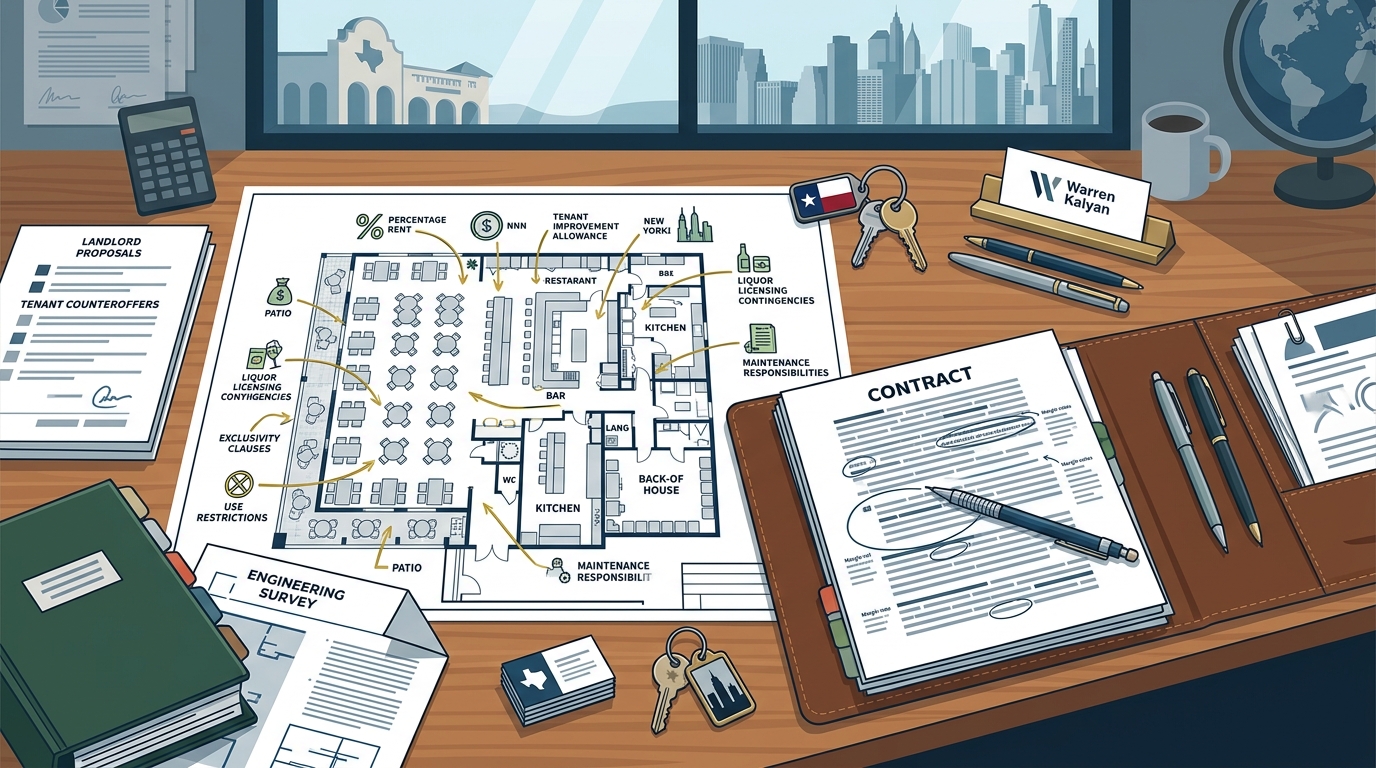
Landlords often resist exclusive use clauses, but for a bar or restaurant, they are vital. An exclusive use clause prevents the landlord from leasing adjacent or nearby spaces to direct competitors. This protects your customer base and brand identity. Without this protection, you risk sharing your foot traffic with a rival venue that might offer similar drinks or cuisine at a lower price point.
Tenant Improvement Allowances
Hospitality venues require significant build-out costs. From commercial kitchens to soundproofing, the capital expenditure is high. Negotiating a robust Tenant Improvement (TI) allowance is essential. This allowance should cover not just cosmetic updates but also the installation of critical infrastructure like grease traps, ventilation systems, and bar fixtures. A well-negotiated TI allowance can reduce your initial cash outlay by tens of thousands of dollars.
Operating Hours and Noise Ordinances
Your ability to operate late into the night is often tied to the lease terms and local zoning laws. In New York City, for example, noise complaints can lead to immediate operational shutdowns. We help structure lease provisions that require the landlord to cooperate in defending against unjustified noise complaints. This ensures that your right to operate is not easily undermined by neighboring residential developments.
Regulatory Compliance and Licensing
The intersection of real estate law and hospitality regulation is where many deals fail. Hospitality law in Texas and New York involves a complex web of local, state, and federal regulations. Our high-volume hospitality and liquor licensing practice shepherds operators through the full regulatory life cycle.
In Texas, the Texas Alcoholic Beverage Commission (TABC) regulations are stringent. A lease must account for the distance requirements from schools and churches, which can vary by municipality. If the property does not meet these criteria, your liquor license application will be denied, rendering the lease useless. We conduct thorough due diligence to ensure the property is eligible for the intended use before you sign anything.
In New York, the process is equally complex. The city has recently announced over 50 regulatory reforms for small businesses, including changes to storefront security gate requirements and liquor licensing procedures. Staying ahead of these changes requires a legal partner who monitors regulatory updates daily. We ensure that your lease includes contingencies for licensing delays, protecting you from paying rent on a venue that cannot legally open.
Litigation Prevention and Dispute Resolution
When things get rocky, our disputes practice steps in with demand letters, injunctive relief, arbitration, and trial-ready advocacy. Business litigation and partnership disputes are a core area of expertise for our firm. We focus on protecting our clients' equity, control, and economic interests.
One common dispute arises from "co-tenancy" clauses. These clauses allow a tenant to reduce rent or terminate the lease if a key anchor tenant leaves the shopping center. In hospitality, the health of the surrounding businesses directly impacts your revenue. We negotiate these clauses to ensure they are triggered by meaningful events, not minor fluctuations in occupancy.
Another critical area is the maintenance of common areas. Landlords often defer maintenance to save costs, which can lead to safety hazards and code violations. We draft precise maintenance obligations that hold the landlord accountable for the condition of the building exterior, parking lots, and shared facilities. This proactive approach prevents costly repairs from falling on your shoulders.
Comparing Lease Negotiation Strategies
Different hospitality venues require different negotiation strategies. A standalone bar has different leverage than a tenant in a large mixed-use development. The table below outlines the key differences in approach based on venue type.
| Venue Type | Primary Negotiation Focus | Risk Mitigation Strategy | Typical Lease Term |
|---|---|---|---|
| Standalone Bar/Restaurant | Exclusive use and signage rights | Licensing contingencies and zoning verification | 5-10 years with renewal options |
| Mixed-Use Retail Tenant | Co-tenancy clauses and foot traffic guarantees | Anchor tenant default provisions | 3-7 years with early termination rights |
| Hotel/Resort | Grounds maintenance and utility capacity | Environmental compliance and insurance caps | 10-20 years with long-term stability |
| Event Venue | Noise ordinances and parking availability | Permitting delays and force majeure clauses | 5-15 years with flexible exit strategies |
Key Takeaways
- Warren Kalyan has been established in Texas since 1980, providing over four decades of legal expertise in business law.
- Hospitality leases require specific clauses for liquor licensing, noise control, and exclusive use to protect operational viability.
- Regulatory reforms in New York City impact small businesses significantly, requiring constant monitoring of local laws.
- Tenant Improvement allowances should cover critical infrastructure like ventilation and grease traps, not just cosmetic updates.
- Co-tenancy clauses are essential for retail tenants to ensure the landlord maintains anchor tenants that drive foot traffic.
- Our firm integrates transactional insight with litigation strength to prevent disputes before they arise.
- We leverage innovative technology and digital-enabled processes to streamline the lease negotiation and compliance process.
Frequently Asked Questions
Can Warren Kalyan help with liquor license applications for a new venue?
Yes, we run a high-volume hospitality and liquor licensing practice across Texas and New York. We handle original applications, transfers, and the full regulatory life cycle for bars, restaurants, and hotels.
What is a co-tenancy clause in a commercial lease?
A co-tenancy clause allows a tenant to reduce rent or terminate the lease if a key anchor tenant leaves the property. This protects your business from losing the foot traffic that drives your revenue.
How do you handle noise complaints in New York City leases?
We structure lease provisions that require the landlord to cooperate in defending against unjustified noise complaints. This ensures your right to operate is not easily undermined by neighboring residential developments.
What are Tenant Improvement allowances and why are they important?
Tenant Improvement (TI) allowances are funds provided by the landlord to cover build-out costs. For hospitality venues, this is critical for covering expensive infrastructure like commercial kitchens and soundproofing.
Does Warren Kalyan offer services in both Texas and New York?
Yes, we have offices in Austin, Texas, and New York City. We provide integrated legal services across both jurisdictions, leveraging our deep understanding of local laws in each state.
What happens if my liquor license is delayed?
We include contingencies in the lease that protect you from paying full rent during licensing delays. This ensures you are not financially burdened while waiting for regulatory approval.
How does Warren Kalyan approach business litigation?
Our disputes practice focuses on protecting client equity and control. We use demand letters, injunctive relief, and trial-ready advocacy to resolve business divorces, partnership disputes, and contract claims.
Schedule Your Consultation
Negotiating a commercial lease for a hospitality venue is a high-stakes endeavor. You need a legal partner who understands the nuances of both real estate and hospitality law. Warren Kalyan is committed to empowering our clients' success through value-driven partnership. We do not just advise. We execute, from formation through exit.
Contact us today to schedule a time to chat. Our team is ready to help you navigate the complexities of your lease negotiation and ensure your venue is set up for long-term success.
Click here to contact our Austin office or visit our New York City office to begin your consultation.