

Choosing the Right Legal Structure for Your Startup: LLC vs. C-Corp
Establishing the correct legal foundation is the first critical step in building a scalable company. Entity formation is the legal process of registering your business with state authorities to define its structure, tax status, and liability protections. According to recent industry data, startups that select the appropriate corporate structure early on reduce their long-term compliance costs by an average of 30 percent compared to those that restructure later. This decision impacts everything from investor readiness to personal asset protection. At Warren Kalyan, we help founders navigate these complexities from formation through exit, ensuring your business is built on a solid legal framework. (Legal Services at Warren)
Why Your Legal Structure Matters
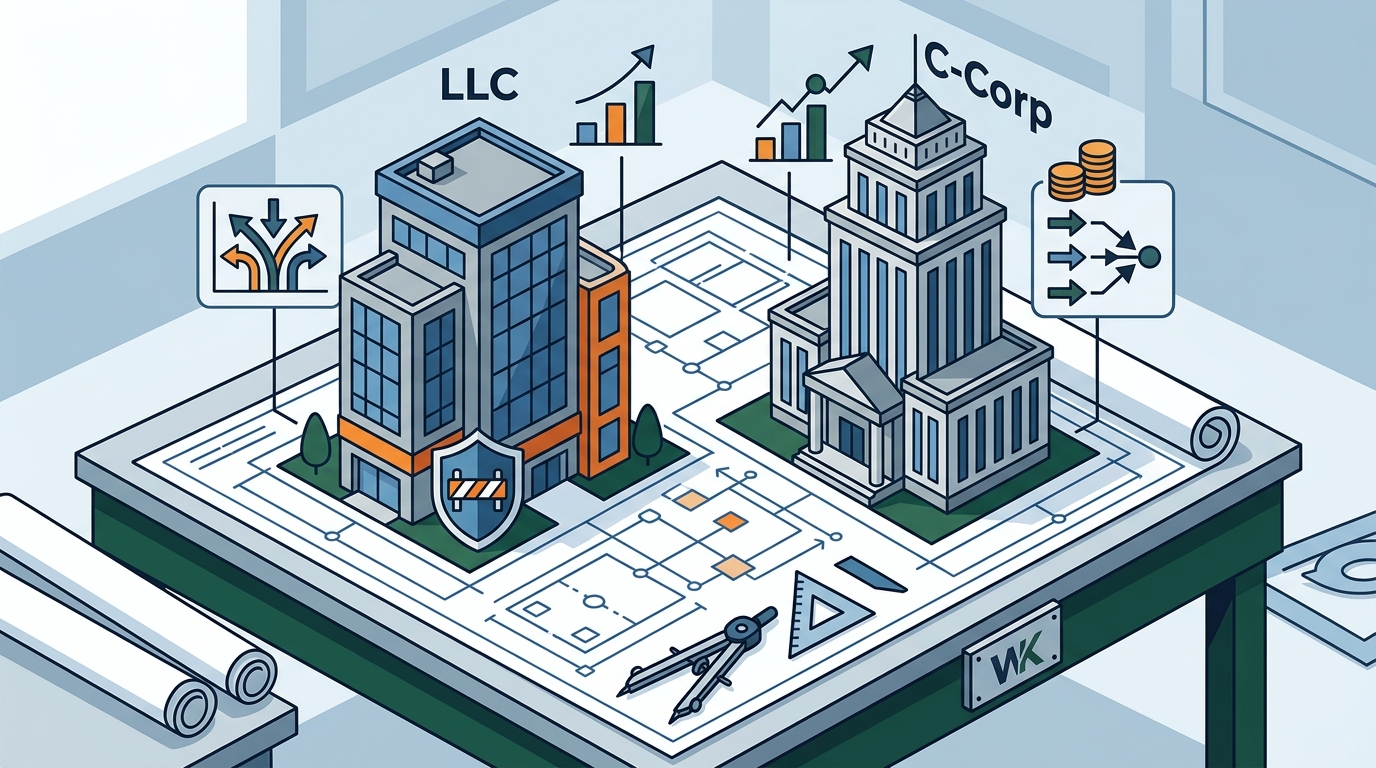
Your choice of legal entity dictates how your company interacts with the government, employees, and investors. A Limited Liability Company (LLC) is a hybrid business structure that provides the limited liability protections of a corporation with the tax benefits and operational flexibility of a partnership. Conversely, a C-Corporation is a distinct legal entity that is taxed separately from its owners, making it the standard for high-growth startups seeking venture capital.
The stakes are high. Incorrect structuring can lead to piercing the corporate veil, where personal assets become vulnerable to business debts. It can also create tax inefficiencies that drain capital during critical growth phases. Our firm has over four decades of experience in Texas and nearly two decades in New York, guiding clients through these exact decisions. We understand that a one-size-fits-all approach does not work for every business model.
For founders in the hospitality or multifamily sectors, the nuances of entity formation are even more critical due to regulatory permitting and licensing requirements. We help clients synthesize strategies that align their legal structure with their operational goals, ensuring they are positioned for success from day one.
LLC vs. C-Corporation: The Core Differences
Understanding the mechanical differences between these two structures is essential for making an informed decision. The primary distinction lies in how profits are distributed and taxed.
Liability Protection
Both LLCs and C-Corporations offer limited liability protection. This means that the owners (members in an LLC, shareholders in a C-Corp) are generally not personally responsible for the company's debts or legal liabilities. This protection is a cornerstone of modern business law, allowing entrepreneurs to take calculated risks without jeopardizing their personal wealth.
Management and Governance
LLCs are typically managed by their members or appointed managers, offering a flexible governance structure defined by an Operating Agreement. C-Corporations, however, require a more rigid structure with a board of directors, officers, and formal shareholder meetings. This formality is often viewed favorably by institutional investors who prefer clear lines of authority and accountability.
Ownership and Equity
C-Corporations issue stock, which makes it easier to issue equity incentives to employees and investors. This is a significant advantage for startups planning to raise capital. LLCs use membership interests, which can be more complex to structure for equity compensation plans. If you plan to bring in angel investors or venture capital, the C-Corp structure is almost always the preferred path.
Investor Readiness and Venture Capital
If your startup aims to raise significant external funding, the choice of legal structure becomes less of a preference and more of a requirement. Most venture capital firms and angel investors prefer to invest in C-Corporations. This preference stems from the familiarity of the corporate structure and the ease of issuing preferred stock.
Investors also need to navigate the tax implications of investing in an LLC. If an LLC raises venture capital, it may be treated as a partnership for tax purposes, potentially creating Unrelated Business Taxable Income (UBTI) for tax-exempt investors, such as university endowments or pension funds. This creates a significant administrative burden for the investor, which is why they often require the startup to convert to a C-Corp before investing.
Our mergers and acquisitions practice frequently handles these conversions. We guide buyers and sellers through the intricacies of asset and equity purchase agreements, ensuring that the transition from an LLC to a C-Corp is seamless and tax-efficient. For more insights on deal structures, you can explore our resources on lower middle market deal playbooks.
Tax Implications and Compliance
Tax strategy is often the deciding factor for bootstrapped startups or those not seeking venture capital. The tax treatment of these entities differs fundamentally.
Pass-Through Taxation for LLCs
LLCs benefit from pass-through taxation. This means the business itself does not pay federal income taxes. Instead, profits and losses are passed through to the members' personal tax returns. This avoids the "double taxation" that C-Corporations face, where the corporation pays taxes on profits, and shareholders pay taxes again on dividends.
Double Taxation for C-Corporations
C-Corporations are subject to double taxation. The corporation pays corporate income tax on its earnings. When those earnings are distributed to shareholders as dividends, the shareholders pay personal income tax on those dividends. However, C-Corps can retain earnings within the company at the corporate tax rate, which can be advantageous for startups reinvesting heavily in growth.
State and Local Compliance
Compliance requirements vary by state. In Texas and New York, both states have specific franchise taxes and annual reporting requirements for LLCs and Corporations. Navigating these regulations requires precise knowledge of local laws. Our firm provides comprehensive compliance support, helping clients manage everything from initial filings to ongoing regulatory updates. For detailed guidance on regulatory compliance, review our blog posts on business compliance.
Comparing Key Operational Factors
The table below summarizes the critical differences between LLCs and C-Corporations to help you evaluate which structure aligns with your startup's goals.
| Factor | LLC (Limited Liability Company) | C-Corporation |
|---|---|---|
| Taxation | Pass-through taxation (no entity-level federal income tax) | Double taxation (corporate tax + shareholder dividend tax) |
| Investor Preference | Less common for VC; may require conversion | Standard for venture capital and angel investors |
| Equity Issuance | Membership interests; complex for stock options | Stock issuance; easy to implement employee stock option plans |
| Governance | Flexible; defined by Operating Agreement | Rigid; requires Board of Directors and formal meetings |
| Profit Distribution | Flexible; can be allocated disproportionately to members | Strictly proportional to share ownership |
| Administrative Burden | Lower; fewer formalities required | Higher; extensive record-keeping and reporting |
Key Takeaways
- Investor Alignment: If you plan to raise venture capital, a C-Corporation is the standard and preferred structure to avoid investor friction.
- Tax Efficiency: LLCs offer pass-through taxation, which can be advantageous for bootstrapped startups wanting to avoid double taxation.
- Liability Protection: Both structures provide limited liability, protecting personal assets from business debts and lawsuits.
- Operational Flexibility: LLCs allow for flexible profit distribution and management structures, while C-Corps require formal governance.
- Conversion Costs: Converting an LLC to a C-Corp later can be tax-inefficient and legally complex; early planning is crucial.
- State Specifics: Texas and New York have distinct franchise tax and reporting requirements that impact the cost of maintaining each structure.
- Strategic Partnership: Choosing the right structure is not just a legal formality but a strategic business decision that affects growth and exit potential.
Frequently Asked Questions
Can I start as an LLC and convert to a C-Corp later?
Yes, you can convert an LLC to a C-Corporation later. However, this process can trigger significant tax consequences, such as capital gains taxes on the appreciation of assets. It is often more efficient to choose the correct structure from the beginning. Our team can help you evaluate the long-term tax implications of a future conversion.
Do I need a lawyer to form my LLC or C-Corp?
While you can file formation documents yourself, the complexity of your business model, state laws, and future plans often necessitates professional guidance. A lawyer ensures that your Operating Agreement or Bylaws are tailored to your specific needs, preventing disputes down the line. Warren Kalyan provides expert entity formation services to set your business up for success.
What is the difference between an S-Corp and a C-Corp?
An S-Corporation is a tax designation, not a business structure. You can elect S-Corp status for an LLC or a C-Corp. S-Corps offer pass-through taxation like an LLC but retain the corporate structure. However, S-Corp status has strict eligibility requirements regarding the number and type of shareholders, which can limit future fundraising.
How does the legal structure affect my ability to hire employees?
The structure impacts how you offer equity compensation. C-Corporations can easily issue stock options, which are a powerful tool for attracting top talent. LLCs can issue profits interests, but these are more complex to administer and may have different tax implications for employees. If equity compensation is a key part of your hiring strategy, a C-Corp is generally more straightforward.
What are the annual compliance requirements for an LLC in Texas?
In Texas, LLCs must file an Annual Franchise Tax Report with the Texas Comptroller. Failure to file can result in penalties and the forfeiture of limited liability protection. Additionally, LLCs must maintain a registered agent in Texas. Our firm assists clients with ongoing compliance to ensure they remain in good standing.
Why do venture capitalists prefer C-Corporations?
Venture capitalists prefer C-Corporations because they can issue preferred stock, which provides investors with specific rights and preferences over common stockholders. This structure is familiar to investors and simplifies the legal and tax aspects of the investment. Investing in an LLC can create Unrelated Business Taxable Income (UBTI) for tax-exempt investors, which they typically want to avoid.
How does Warren Kalyan help with startup formation?
We provide comprehensive entity formation services, including drafting Operating Agreements or Bylaws, filing state documents, and obtaining EINs. We also advise on the strategic implications of each structure based on your industry and growth plans. Our approach is rooted in value, efficiency, and effectiveness, ensuring you make informed decisions from the start.
Schedule Your Consultation
Choosing the right legal structure is a foundational decision that shapes your startup's future. Do not leave this critical step to chance. Partner with a firm that understands the nuances of business law in Texas and New York. Warren Kalyan is committed to empowering your success through value-driven partnership. We do not just advise; we execute, from formation through exit.
Contact us today to schedule a time to chat. Our team is ready to help you navigate entity formation, regulatory compliance, and strategic growth. Visit our contact page to get started.