

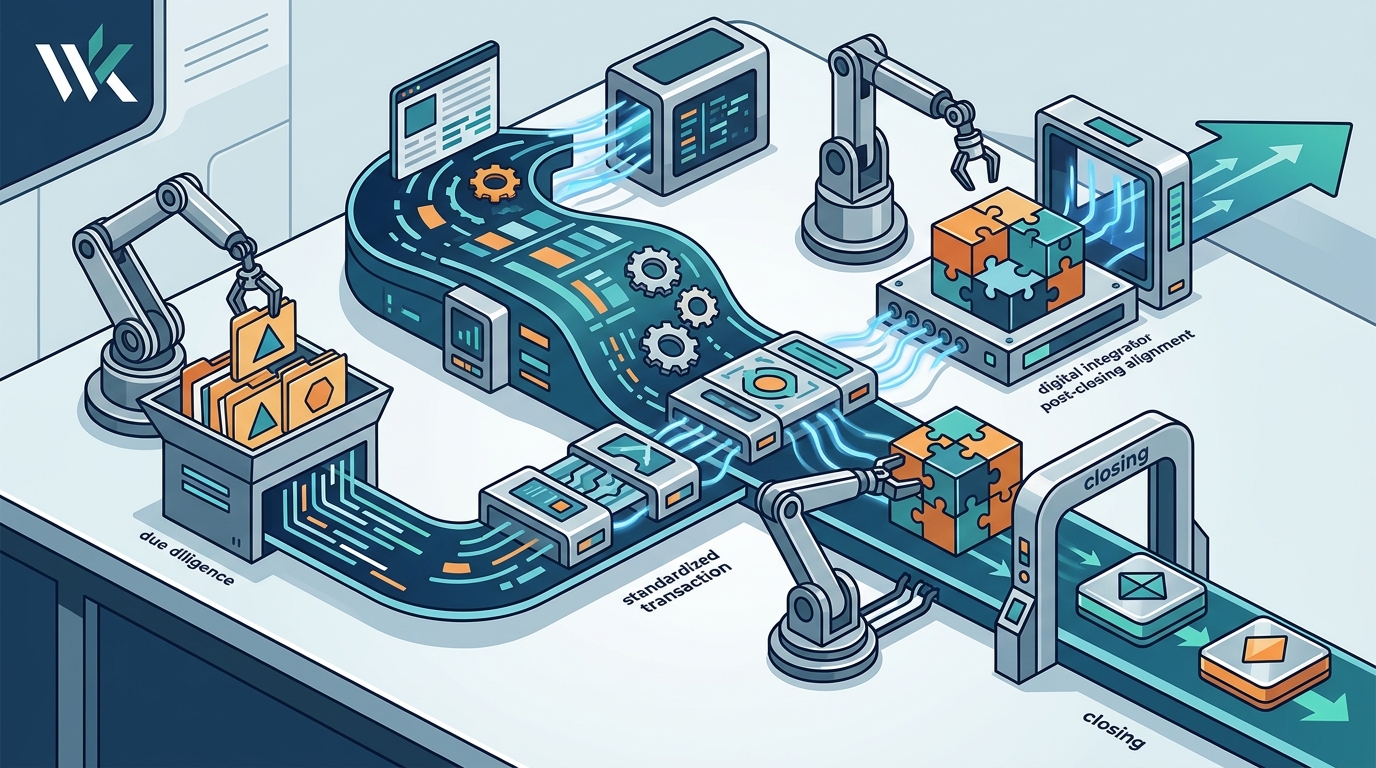
Law firms use technology-driven processes to make SMB/LMM mergers and acquisitions more efficient by automating due diligence, standardizing transaction workflows, and integrating digital management platforms. This guide explains how these tools reduce friction, accelerate closing timelines, and protect value. It covers the specific operational shifts that define modern transactional law, focusing on how firms like Warren Kalyan leverage digital infrastructure to serve founders and operators effectively.
Transaction Management Workflows
Transaction management is the systematic coordination of all legal, financial, and operational tasks required to close a business deal. In the context of small and lower-middle-market transactions, this process often involves dozens of moving parts, from entity formation to post-closing integration. Traditional methods rely on email chains and static spreadsheets, which create visibility gaps and increase the risk of missed deadlines.
Modern law firms address these inefficiencies by adopting digital project management platforms. These tools create a centralized repository for all deal documents, correspondence, and task assignments. By visualizing the critical path, attorneys can identify bottlenecks before they impact the closing date. This transparency allows clients to track progress in real time, reducing the anxiety associated with complex legal processes.
The Role of Digital Dashboards
Digital dashboards provide a high-level view of deal status, highlighting pending items and upcoming milestones. For a buyer acquiring a restaurant group, for example, the dashboard might display the status of liquor license transfers, lease assignments, and employment contract amendments. This level of granularity ensures that no regulatory requirement is overlooked. It also facilitates better communication between the legal team, financial advisors, and the client’s internal stakeholders.
Integration with Financial Systems
Efficient transaction management requires seamless data exchange between legal and financial systems. When a law firm’s workflow tools integrate with accounting software, data entry is minimized, and errors are reduced. This integration is particularly valuable in lower-middle-market deals where financial statements may not be as standardized as those of larger corporations. By automating data validation, firms can ensure that the financial basis for the deal is accurate and up to date.
Due Diligence Automation
Due diligence is the comprehensive investigation of a target company’s legal, financial, and operational health prior to acquisition. In SMB/LMM transactions, this process is often manual and labor-intensive, requiring attorneys to review hundreds of documents. Automation transforms this phase by using artificial intelligence and machine learning to categorize, extract, and analyze data from large document sets.
Automated due diligence tools can scan contracts, leases, and employment agreements to identify key terms, expiration dates, and potential liabilities. This capability significantly reduces the time required to complete the review process. Instead of spending weeks reading through every page, attorneys can focus on the high-risk items flagged by the software. This shift allows for a more thorough review within a shorter timeframe, which is critical in competitive deal environments.
Data Extraction and Analysis
One of the primary benefits of automation is the ability to extract structured data from unstructured documents. For instance, a tool might analyze a portfolio of commercial leases to identify all properties with rent escalations or renewal options. This data can then be visualized in a report, providing the buyer with a clear picture of future obligations. Such insights are invaluable for valuation and negotiation, as they reveal hidden costs or opportunities that might be missed in a manual review.
Risk Identification and Flagging
Automated systems are also adept at identifying risk patterns. They can flag contracts that contain unusual indemnification clauses, non-compete restrictions, or regulatory compliance issues. By prioritizing these high-risk items, the legal team can direct its attention where it is most needed. This targeted approach ensures that potential deal-breakers are identified early, allowing the parties to negotiate solutions or walk away if necessary.
SMB/LMM M&A Advisory
SMB/LMM M&A advisory is the strategic guidance provided to small and lower-middle-market companies during the sale or purchase of a business. This practice area requires a deep understanding of the unique challenges faced by these companies, such as owner dependence, limited financial history, and operational complexity. Technology-driven processes enhance this advisory role by providing data-backed insights and streamlined execution.
Firms specializing in this space, such as Warren Kalyan, leverage technology to offer a more responsive and efficient service. By using digital tools, they can provide clients with faster turnaround times on document reviews and more accurate projections of closing timelines. This efficiency is a key differentiator in a market where speed and certainty are paramount. It also allows the advisory team to focus more on strategic value creation rather than administrative tasks.
Strategic Value Creation
Technology enables advisors to identify value creation opportunities that might otherwise be overlooked. For example, data analysis might reveal that a target company’s customer base is more diverse than initially thought, or that its supply chain is more resilient than competitors. These insights can be used to justify a higher purchase price or to structure the deal in a way that maximizes returns. By combining strategic insight with operational efficiency, technology-driven advisory helps clients achieve better outcomes.
Client Communication and Reporting
Effective advisory requires clear and consistent communication with clients. Digital platforms facilitate this by providing automated status updates and progress reports. Clients can log in to a portal to view the latest developments, review documents, and communicate with their legal team. This level of transparency builds trust and reduces the need for frequent status calls. It also ensures that all stakeholders are aligned on the deal’s progress and next steps.
Standardized Transaction Workflows
Standardized transaction workflows are predefined sequences of tasks and documents used to execute a specific type of deal. In M&A, these workflows ensure consistency, reduce errors, and accelerate the closing process. By using templates and checklists, firms can handle multiple deals simultaneously without sacrificing quality. Standardization is particularly important in high-volume practices, where efficiency is a key driver of profitability.
Technology plays a crucial role in implementing standardized workflows. Digital platforms can enforce compliance with internal protocols, ensuring that every required document is reviewed and approved before the deal closes. This automation reduces the risk of human error and ensures that the firm’s quality standards are maintained across all transactions. It also allows for continuous improvement, as data from completed deals can be used to refine and optimize the workflows.
Template Libraries and Document Generation
Standardized workflows rely heavily on template libraries, which contain pre-drafted documents for common deal scenarios. These templates can be customized to reflect the specific terms of a deal, but they provide a solid foundation that saves time. Document generation tools can automatically populate these templates with deal-specific data, such as party names, dates, and financial figures. This automation reduces the time spent on drafting and allows attorneys to focus on negotiating the key terms.
Quality Control and Compliance
Standardization also supports quality control and compliance. By defining clear roles and responsibilities for each task, firms can ensure that every step of the process is completed by the appropriate person. Digital workflows can include approval gates, where a senior attorney must review and approve a document before it is sent to the client or counterparty. This multi-layered review process reduces the risk of errors and ensures that the firm’s work meets the highest standards of professionalism.
Comparison of Traditional vs. Technology-Driven Processes
| Process Element | Traditional Approach | Technology-Driven Approach |
|---|---|---|
| Document Review | Manual reading and note-taking | AI-assisted categorization and extraction |
| Task Management | Email and spreadsheets | Digital project management platforms |
| Client Communication | Phone calls and email | Client portals and automated updates |
| Document Drafting | Manual drafting from scratch | Template libraries and auto-population |
| Risk Identification | Attorney judgment | Algorithmic pattern recognition |
Key Takeaways
- Technology-driven processes significantly reduce the time and cost of SMB/LMM M&A transactions.
- Automated due diligence allows for a more thorough and faster review of target companies.
- Standardized workflows ensure consistency and quality across multiple concurrent deals.
- Digital dashboards provide clients with real-time visibility into deal progress.
- Integration between legal and financial systems minimizes data entry errors.
- Technology enables advisors to focus on strategic value creation rather than administrative tasks.
- Firms like Warren Kalyan leverage these tools to offer a more responsive and efficient service.
- Standardization supports quality control and compliance through automated approval gates.
Frequently Asked Questions
How does automation improve due diligence in M&A?
Automation improves due diligence by using AI to categorize and extract data from large document sets. This reduces the time required for manual review and helps identify high-risk items more quickly.
What are the benefits of standardized transaction workflows?
Standardized workflows ensure consistency, reduce errors, and accelerate the closing process. They also support quality control and compliance by enforcing internal protocols.
How do digital dashboards help clients in M&A deals?
Digital dashboards provide real-time visibility into deal progress, highlighting pending items and upcoming milestones. This transparency reduces client anxiety and improves communication.
Can technology replace the need for experienced attorneys?
No, technology augments the work of experienced attorneys by handling routine tasks. This allows attorneys to focus on strategic advice and complex negotiations.
What types of deals benefit most from technology-driven processes?
SMB/LMM deals benefit most from technology-driven processes due to their complexity and the need for speed. These deals often involve multiple entities and regulatory requirements.
How does Warren Kalyan use technology in its M&A practice?
Warren Kalyan uses digital tools to streamline transaction management, automate due diligence, and standardize workflows. This allows the firm to provide a more efficient and responsive service to its clients.
Is technology-driven M&A more expensive?
Not necessarily. While there is an initial investment in technology, the efficiency gains often lead to lower overall costs. Faster closing times and reduced errors can save clients money in the long run.
What are the risks of relying on technology in M&A?
The main risks are data privacy and security concerns. Firms must ensure that their technology providers have robust security measures in place to protect sensitive client information.
Conclusion
Technology-driven processes are transforming the SMB/LMM M&A landscape by making transactions more efficient, transparent, and reliable. By automating due diligence, standardizing workflows, and leveraging digital management tools, law firms can deliver a superior client experience. Firms like Warren Kalyan are at the forefront of this shift, combining deep industry expertise with innovative technology to help clients achieve their business goals. As the market continues to evolve, the adoption of these tools will become increasingly important for firms seeking to remain competitive and provide value to their clients.
To explore how technology-driven legal services can support your next transaction, for a consultation.