

Establishing the correct legal foundation is the single most critical decision a founder makes before generating revenue. According to recent industry data, over 65% of small business failures are linked to poor initial structural planning, tax inefficiencies, or inadequate liability protection. This statistic highlights why choosing between an LLC, C-Corp, or S-Corp is not merely an administrative task but a strategic imperative. At Warren Kalyan, we have guided thousands of clients through this exact process since 1980, ensuring that their operational framework supports long-term growth rather than hindering it. This guide details the precise steps to structure your new business entity effectively in Texas and New York. (Contact Us warren kalyan)
Understanding Core Entity Types
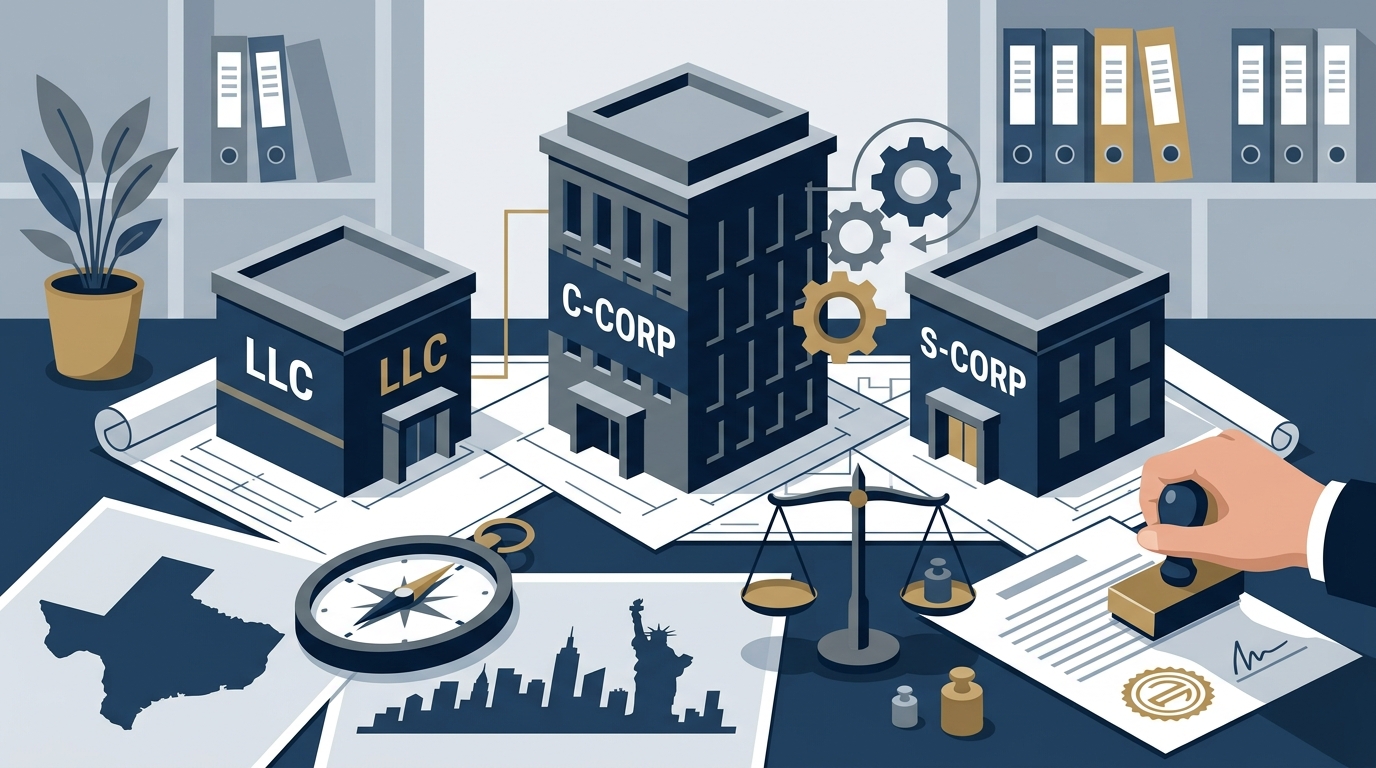
Before filing any paperwork, you must define the legal vehicle that will house your business operations. The three primary structures for new businesses are the Limited Liability Company (LLC), the C Corporation, and the S Corporation. Each offers distinct advantages regarding liability protection, taxation, and governance.
What is an LLC?
An LLC is a hybrid business structure that provides the limited liability features of a corporation and the tax efficiencies and operational flexibility of a partnership. This entity type is the most popular choice for small to medium-sized businesses in Texas and New York due to its simplicity and protection of personal assets.
What is a C Corporation?
A C Corporation is a legal entity that is separate and distinct from its owners. It offers the strongest protection against personal liability and is the required structure for companies planning to go public or seek significant venture capital investment. However, it is subject to double taxation on corporate income.
What is an S Corporation?
An S Corporation is not a business entity itself but a tax classification. To qualify, a corporation or LLC must meet specific IRS requirements, such as having no more than 100 shareholders. This status allows income to be passed through to shareholders, avoiding double taxation while retaining corporate liability protection.
Texas-Specific Regulatory Requirements
Texas is known for its business-friendly environment, but it has specific filing requirements that differ significantly from other states. Understanding these nuances is essential for proper formation.
Formation Documents
In Texas, you must file a Certificate of Formation with the Secretary of State. This document establishes your LLC or Corporation as a legal entity. For LLCs, the form is relatively simple, requiring the name, registered agent information, and organizer details. For corporations, the Certificate of Formation is more detailed, including authorized share counts and director information.
Registered Agent Requirements
Every Texas business must maintain a registered agent with a physical address in the state. This agent receives legal documents, such as lawsuits or official government notices, on behalf of the company. Warren Kalyan provides comprehensive guidance on selecting and managing registered agent services to ensure compliance.
Franchise Tax Considerations
Texas imposes a franchise tax on most business entities. While many small LLCs may not owe tax if their revenue falls below the threshold, the reporting requirements are strict. Failure to file even if no tax is due can result in penalties and loss of good standing. Our team at Warren Kalyan helps clients navigate these annual reporting obligations to maintain their legal status.
New York Compliance and Publication Rules
New York has one of the most unique and stringent compliance requirements for LLCs: the Publication Requirement. This rule often catches new business owners off guard, leading to administrative dissolution if ignored.
The Publication Requirement Explained
After forming an LLC in New York, you must publish a notice of formation in two newspapers designated by the county clerk in the county where your LLC is located. This publication must run once a week for four consecutive weeks. One newspaper must be a daily publication, and the other must be a weekly publication.
Proof of Publication
Once the publication period is complete, the newspapers will provide affidavits of publication. You must then file these affidavits with the New York Department of State along with a $50 filing fee. Until this step is completed, your LLC does not have the legal authority to conduct business in New York. This process is complex and time-sensitive, making professional assistance invaluable.
Biennial Statements
New York LLCs must also file a Biennial Statement every two years, which is a simple notification of the LLC's current address and officer information. Failure to file this statement results in the administrative dissolution of the entity. For more details on ongoing compliance, review our business law blog.
Tax Implications and Election Strategies
The tax structure of your entity determines how much of your revenue you keep and how complex your accounting will be. Strategic tax planning at the formation stage can save businesses hundreds of thousands of dollars over time.
Pass-Through Taxation
LLCs and S Corporations benefit from pass-through taxation, where business profits and losses are reported on the owners' personal tax returns. This avoids the double taxation faced by C Corporations. However, owners of pass-through entities are subject to self-employment taxes on their share of the profits.
Corporate Taxation
C Corporations pay a flat 21% federal corporate income tax. If the corporation distributes dividends to shareholders, those dividends are taxed again at the individual level. This structure is often advantageous for businesses planning to reinvest profits for rapid growth or seek institutional investment.
State Tax Variations
Tax rates and regulations vary significantly between Texas and New York. Texas has no personal income tax, which is a major advantage for owners. New York, however, has some of the highest individual income tax rates in the nation. This disparity can influence where you choose to form your entity and where you locate your operations.
The Critical Role of Operating Agreements
An Operating Agreement is the internal rulebook for your LLC. While Texas and New York do not legally require you to file this document with the state, it is arguably the most important legal document you will create.
Defining Ownership and Management
The Operating Agreement outlines the ownership percentages of each member and the management structure of the company. It specifies how decisions are made, how profits are distributed, and what happens if a member wants to leave or pass away. Without this agreement, your business defaults to the state's default rules, which may not align with your intentions.
Protecting Limited Liability
Having a formal Operating Agreement helps maintain the separation between your personal and business assets. In the event of a lawsuit, courts look to this document to determine if the business is being operated as a distinct entity. A well-drafted agreement reinforces this separation, protecting your personal assets from business liabilities.
Dispute Resolution Mechanisms
Include clear dispute resolution mechanisms in your Operating Agreement. This can include mediation or arbitration clauses that prevent costly and time-consuming litigation among members. Our disputes practice frequently handles cases where the lack of a clear Operating Agreement led to irreparable partnership breakdowns.
Key Takeaways
- Entity Selection is Strategic: Choose between LLC, C-Corp, or S-Corp based on your long-term goals, tax situation, and funding needs.
- Texas Franchise Tax: All Texas entities must file annual franchise tax reports, even if no tax is owed, to maintain good standing.
- New York Publication Rule: New York LLCs must publish formation notices in two newspapers for four weeks and file proof with the Department of State.
- Operating Agreements are Essential: Do not rely on state default rules. Draft a comprehensive Operating Agreement to define governance and protect liability.
- Registered Agent Compliance: Maintain a valid registered agent in both states to ensure timely receipt of legal documents.
- Biennial Filings: New York LLCs must file Biennial Statements every two years to avoid administrative dissolution.
- Professional Guidance: Navigating the complexities of Texas and New York law requires experienced counsel to avoid costly mistakes.
Frequently Asked Questions
What is the difference between an LLC and a Corporation?
An LLC offers flexible management and pass-through taxation, while a Corporation provides a more formal structure with potential for easier capital raising but subject to double taxation.
Do I need a registered agent in both Texas and New York?
If your business operates in both states, you must maintain a registered agent in each state where you are qualified to do business to receive legal notices.
How much does it cost to form an LLC in New York?
The filing fee for the Certificate of Formation is $200. However, you must also pay for newspaper publication, which can range from $500 to $2,000 depending on the county, plus a $50 filing fee for the proof of publication.
Can I form an LLC in Texas if I live in New York?
Yes, you can form an LLC in Texas, but if you conduct business in New York, you must register as a foreign LLC in New York and comply with its publication requirements.
What happens if I fail to publish in New York?
Failure to publish and file proof of publication can result in the administrative dissolution of your LLC and the loss of the right to conduct business in New York.
Do I need an Operating Agreement for a single-member LLC?
Yes, even single-member LLCs should have an Operating Agreement to clearly define the owner's rights and maintain liability protection.
How often do I need to file reports in Texas?
Texas LLCs must file an Annual Franchise Tax Report each year by June 1st to maintain their good standing with the state.
Schedule Your Consultation
Structuring your new business entity correctly is the foundation of your legal and financial success. Whether you are forming in Texas, New York, or both, the expertise of experienced business attorneys is invaluable. Warren Kalyan has been empowering clients since 1980 with value-driven legal partnerships. We do not just advise; we execute from formation through exit.
Do not leave your business structure to chance. Contact our team today to schedule a consultation and ensure your entity is built for resilience and growth. Visit our connect page to book a time to chat with our experts.