

Establishing a new business is a pivotal moment that defines your legal and financial trajectory for years to come. According to recent industry data, over 40% of new businesses fail within the first five years, often due to poor foundational planning and inadequate legal structuring. The way you choose to organize your company, whether as a Limited Liability Company (LLC), a C-Corporation, or an S-Corporation, directly impacts your personal liability protection, tax obligations, and ability to raise capital. This guide provides a detailed roadmap for entrepreneurs in Texas and New York, two of the most dynamic but legally distinct business environments in the United States. (Texas and New York)
Understanding Core Entity Types
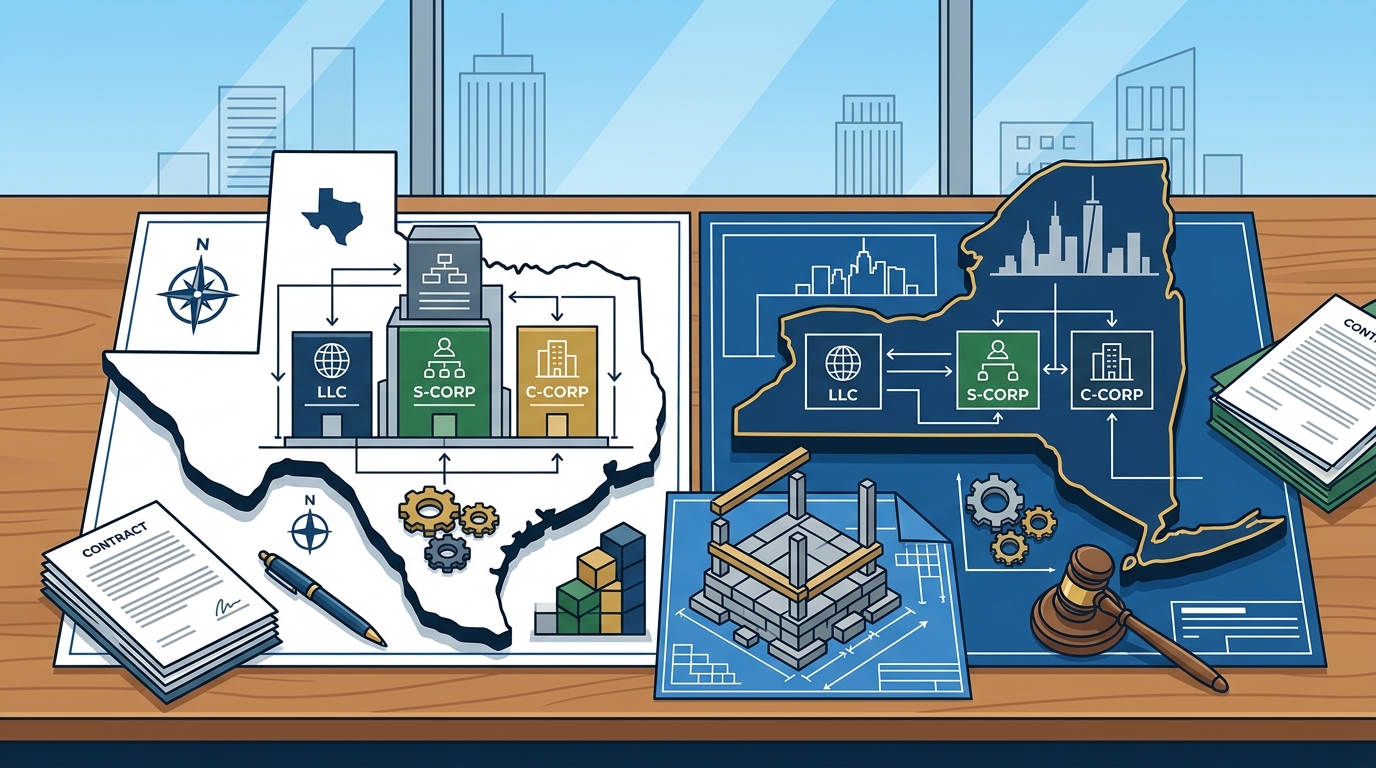
Before filing any paperwork, you must determine the most suitable legal structure for your specific business goals. The three primary structures for small to medium-sized enterprises are the Limited Liability Company (LLC), the C-Corporation, and the S-Corporation. Each offers distinct advantages and disadvantages regarding liability, taxation, and administrative burden.
An LLC is a hybrid business structure that provides the limited liability features of a corporation and the tax efficiencies and operational flexibility of a partnership. LLC is a flexible business structure that combines the pass-through taxation of a partnership or sole proprietorship with the limited liability of a corporation. This makes it a popular choice for small business owners who want to protect their personal assets while maintaining simplicity in tax filing.
A C-Corporation is a separate legal entity that is taxed separately from its owners. It offers the strongest protection against personal liability and is the standard structure for companies seeking venture capital or planning to go public. However, it is subject to double taxation, where profits are taxed at the corporate level and again when distributed as dividends to shareholders.
An S-Corporation is not a business entity itself but a tax classification. To become an S-Corp, a corporation or LLC must file Form 2553 with the IRS. This status allows income to be passed through directly to shareholders, avoiding double taxation. S-Corporation is a tax designation that allows businesses to avoid double taxation by passing corporate income, losses, deductions, and credits through to their shareholders for federal tax purposes. This is particularly beneficial for profitable businesses where the owners wish to reduce self-employment taxes.
The Texas Formation Process
Texas is known for its business-friendly environment, with no state income tax and a streamlined formation process. However, the state has specific requirements that must be met to ensure your entity is valid and in good standing.
Step 1: Choose and Reserve a Name
Your business name must be distinguishable from other entities registered with the Texas Secretary of State. You can search for name availability on the Texas SOS portal. While not mandatory, you can reserve a name for up to two years by filing a Name Reservation Application.
Step 2: File the Certificate of Formation
For an LLC, you must file the Certificate of Formation (Form 205) with the Texas Secretary of State. This document includes the LLC's name, registered agent information, and whether it will be manager-managed or member-managed. The filing fee is currently $300 for standard processing. Filing online is the fastest method, typically resulting in approval within one to two business days.
Step 3: Appoint a Registered Agent
Texas requires every LLC to have a registered agent with a physical street address in the state. The agent is responsible for receiving legal documents, such as service of process, on behalf of the LLC. You can act as your own agent if you have a physical presence in Texas, or you can hire a professional service.
Step 4: File the Franchise Tax Report
Even if your LLC has no income or no tax liability, you must file an initial franchise tax report within the 120th day after the tax period begins. Failure to do so can result in penalties and the loss of good standing. The Texas Comptroller's office oversees these filings and provides detailed guidelines for new entities.
The New York Formation Process
New York presents a more complex regulatory landscape, particularly regarding publication requirements and franchise taxes. Entrepreneurs must navigate these hurdles carefully to avoid administrative dissolution or significant penalties.
Step 1: File the Articles of Organization
Similar to Texas, you must file the Articles of Organization (Form DOS-1336) with the New York Department of State. This can be done online or by mail. The filing fee is $200. The articles must include the LLC's name, county of residence, and the name and address of the registered agent.
Step 2: Publish a Notice of Formation
This is the most unique and costly aspect of forming an LLC in New York. Within 120 days of filing your Articles of Organization, you must publish a notice of formation in two newspapers (one daily and one weekly) in the county where the LLC's office is located. After publication, you must file a Certificate of Publication with the Department of State, along the $50 filing fee. New York Department of State publication rules are strict, and failure to comply can result in the LLC being unable to maintain a lawsuit in state courts.
Step 3: File the Biennial Statement
New York requires LLCs to file a Biennial Statement every two years, updating the department on the LLC's address and registered agent. The fee is $9. This is a simple but often overlooked requirement that keeps your entity in good standing.
Tax Implications and Elections
Understanding the tax landscape is crucial for structuring your entity effectively. Texas and New York have vastly different tax structures that will impact your bottom line.
Texas Tax Structure
Texas does not impose a personal income tax, which is a significant advantage for business owners. However, it does have a franchise tax, which is effectively a margin tax on businesses. Most small LLCs are not subject to this tax if their margin is below a certain threshold, but they must still file a no-tax due report. Texas Comptroller franchise tax guidelines provide detailed thresholds and filing requirements.
New York Tax Structure
New York imposes both personal and corporate income taxes. LLCs are generally treated as pass-through entities for federal tax purposes, meaning profits are reported on the owners' personal tax returns. However, New York also has a separate entity tax for LLCs, which is calculated based on the LLC's income allocated to New York. New York State Department of Taxation and Finance offers comprehensive resources for understanding these obligations.
The Critical Role of Operating Agreements
While Texas does not legally require an LLC to have an operating agreement, it is highly recommended. New York requires LLCs to have an operating agreement, but it does not need to be filed with the state. This document is the internal rulebook for your LLC, outlining ownership percentages, voting rights, profit distribution, and procedures for adding or removing members.
Without an operating agreement, your LLC will be governed by the default rules of the state, which may not align with your business intentions. An operating agreement is a legal document that outlines the ownership structure and member responsibilities of an LLC. It is particularly important for multi-member LLCs to prevent disputes and ensure smooth operations.
Warren Kalyan specializes in drafting customized operating agreements that protect your interests and align with your business goals. Our team understands the nuances of Texas and New York law, ensuring your agreement is robust and enforceable. Learn more about our business formation services to get started.
Ongoing Compliance and Maintenance
Forming your LLC is just the beginning. Maintaining your entity's good standing requires ongoing compliance with state and federal regulations.
Annual Reports and Fees
Texas requires an annual franchise tax report, while New York requires a Biennial Statement. Both states impose penalties for late filings. Additionally, you must maintain your registered agent and update your business address as needed.
Employer Identification Number (EIN)
Most LLCs need an EIN from the IRS to open bank accounts, hire employees, and file taxes. You can apply for an EIN online through the IRS website for free. This number is essential for separating your personal and business finances.
Licenses and Permits
Depending on your industry, you may need specific licenses and permits to operate legally. For example, hospitality businesses in Texas and New York must navigate complex liquor licensing regulations. Our hospitality law blog provides insights into these regulatory requirements.
Key Takeaways
- Entity Choice Matters: LLCs offer flexibility and liability protection, while C-Corps are better for raising venture capital.
- Texas Simplicity: Texas has no state income tax and a straightforward formation process, but requires franchise tax reporting.
- New York Complexity: New York requires newspaper publication for LLCs, adding cost and time to the formation process.
- Operating Agreements are Essential: They define member rights and prevent disputes, even if not always legally required to be filed.
- Compliance is Ongoing: Annual reports, franchise taxes, and licenses must be maintained to keep your entity in good standing.
- Tax Elections: Consider S-Corp election if your LLC is profitable enough to benefit from reduced self-employment taxes.
- Professional Guidance: Navigating two different state legal systems requires expert advice to avoid costly mistakes.
Frequently Asked Questions
What is the difference between an LLC and a Corporation?
An LLC is a flexible structure with pass-through taxation and fewer formalities, while a Corporation is a more formal structure with potential for double taxation but greater ability to raise capital through stock issuance.
Do I need a registered agent in Texas and New York?
Yes, both states require LLCs to have a registered agent with a physical address in the state to receive legal documents.
How much does it cost to form an LLC in New York?
Beyond the $200 filing fee and $50 publication filing fee, the cost of newspaper publication in New York can vary significantly by county, often ranging from $500 to $2,000 or more.
Can I form an LLC in Texas if I live in New York?
Yes, you can form an LLC in Texas regardless of your residence, but you will need a registered agent in Texas and must comply with Texas ongoing compliance requirements.
What is the franchise tax in Texas?
The Texas franchise tax is a margin tax imposed on entities doing business in Texas. Most small LLCs may not owe tax but must still file a report.
How long does it take to form an LLC in New York?
While the initial filing can be processed quickly, the 120-day publication window and subsequent filing can extend the time to full operational readiness.
Do I need an operating agreement for my LLC?
While Texas does not require it, New York does. Regardless of state law, an operating agreement is crucial for defining member rights and preventing disputes.
Schedule Your Consultation
Structuring your new business entity is a critical decision that requires careful consideration of legal, tax, and operational factors. Whether you are forming an LLC in Texas or New York, or navigating the complexities of multi-state operations, Warren Kalyan is here to help. Our team of experienced business attorneys provides strategic guidance from formation through exit, ensuring your business is built on a solid legal foundation.
Do not navigate this complex landscape alone. Contact Warren Kalyan today to schedule a consultation and discuss your business formation needs. We offer value-driven partnership and execution, helping you focus on growing your business while we handle the legal machinery behind your decisions. Visit our contact page to get started.