

Multi-State Legal Support Models: In-House vs. Outside Counsel for Texas and New York Operations
Operating a business across state lines introduces a complex web of regulatory requirements that can quickly overwhelm standard operational frameworks. Data shows that companies expanding into multiple jurisdictions face a 40% increase in compliance overhead during the first two years of multi-state operations. For businesses establishing a footprint in both Texas and New York, the legal landscape is particularly divergent. Texas offers a business-friendly regulatory environment with streamlined entity formation, while New York imposes rigorous reporting, franchise tax, and labor compliance mandates. Navigating this dichotomy requires a deliberate choice between building an internal legal team or engaging specialized outside counsel. This guide analyzes the structural, financial, and operational implications of each model to help you select the right support system for your growth trajectory. (Contact Us warren kalyan)
Understanding the Texas-New York Regulatory Dichotomy
The legal requirements for multi-state operations are not merely different; they are often contradictory. A strategy that ensures compliance in Austin may create liability in Manhattan. According to recent regulatory updates, the definition of "small business" for SBA financing and state-level tax thresholds has shifted significantly in 2026, affecting how companies structure their entity formations. Understanding these baseline differences is the first step in selecting your legal support model. (Texas and New York)
Entity Formation and Governance
In Texas, the Secretary of State offers a streamlined process for forming Limited Liability Companies (LLCs) and corporations, with minimal ongoing reporting requirements beyond annual franchise tax reports. Delaware recently raised entity law costs in 2026, prompting many firms to reconsider their domicile, but Texas remains a competitive alternative for domestic operations. Conversely, New York requires a Publication Requirement for LLCs, where owners must publish notices in designated newspapers for six weeks. This process is costly and administratively burdensome, often requiring specialized expediting services to ensure compliance. (Business Law Blog Texas)
Labor and Employment Compliance
Employment law is perhaps the most volatile area for multi-state operators. Two major Labor Department rules are currently being implemented to redraw worker classification standards, impacting how businesses categorize independent contractors versus employees. Texas generally follows at-will employment principles with fewer statutory protections, while New York enforces strict paid leave laws, wage theft prevention acts, and detailed overtime calculations. A misstep in New York can result in significant penalties, whereas the same action in Texas might go unnoticed until a dispute arises.
The In-House Legal Team Model
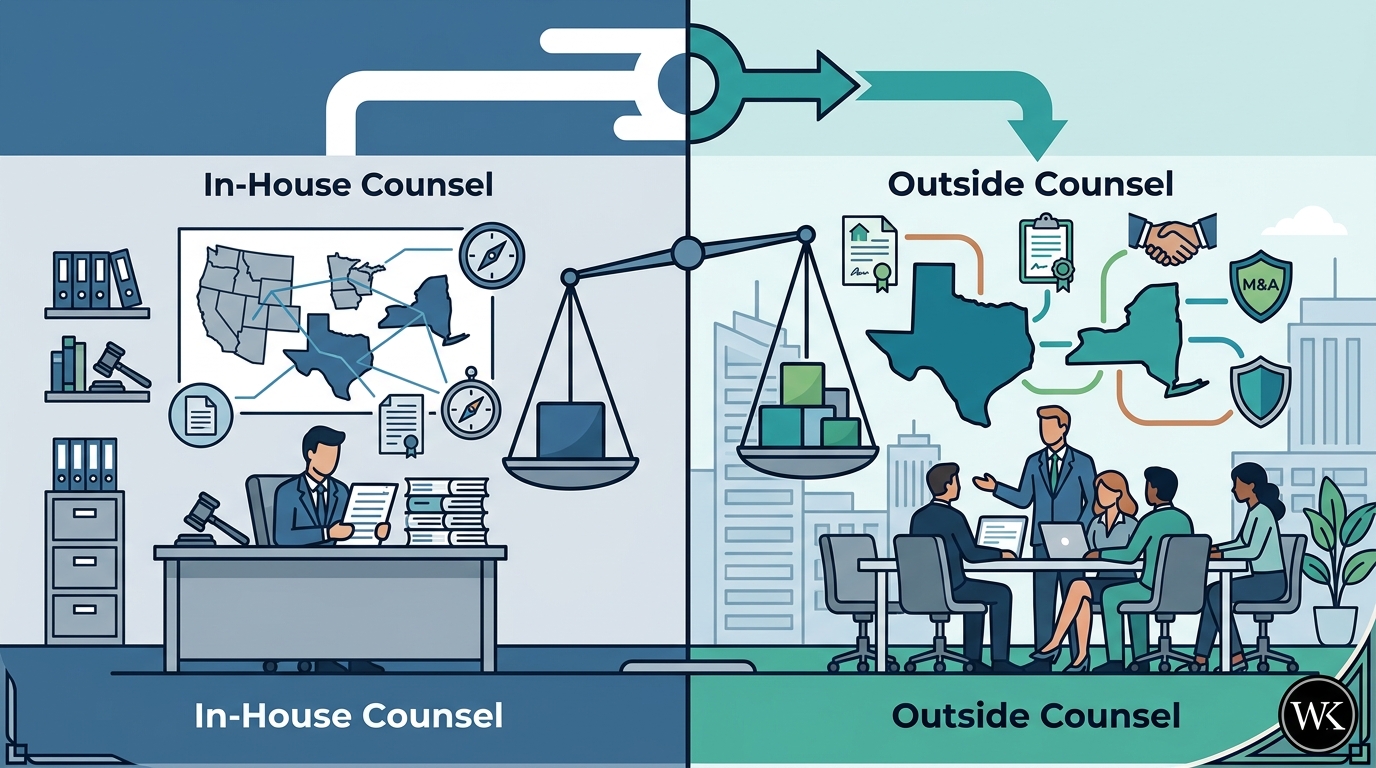
The in-house model involves hiring full-time attorneys to manage legal affairs internally. This approach is often favored by large enterprises with high-volume, repetitive legal needs.
Advantages of Internal Counsel
Having legal experts on staff provides immediate access to institutional knowledge. Warren Kalyan has built a well-established presence in Texas for over four decades and in New York for close to two decades, demonstrating that long-term relationships and deep local knowledge are critical. An in-house team can replicate this depth by hiring attorneys with specific state bar admissions. They offer rapid response times for day-to-day operational questions, from contract reviews to employment disputes. This model also ensures that legal strategy is fully aligned with business objectives, as the legal team is embedded in the corporate culture.
Disadvantages and Cost Implications
However, the in-house model carries significant fixed costs. Salaries, benefits, and technology subscriptions for two or more attorneys in different states can exceed $500,000 annually. Furthermore, maintaining expertise in both Texas and New York requires continuous professional development. The independent contractor rules are changing again, requiring employers to constantly update their internal policies. An in-house team must dedicate substantial time to monitoring these changes, potentially diverting focus from core business strategy. For small to mid-sized businesses, this cost-to-benefit ratio is often unsustainable.
The Outside Counsel and Hybrid Model
The outside counsel model involves retaining law firms or individual attorneys on a retainer or hourly basis to handle legal matters. A hybrid approach combines a lean internal general counsel with specialized outside firms for state-specific issues.
Strategic Flexibility and Expertise
Outside counsel provides access to specialized expertise without the overhead of full-time employment. Warren Kalyan represents companies across a wide range of industries, with particular depth in the highly active hospitality and multifamily real estate sectors. This depth of industry fluency is difficult to replicate in-house unless you operate in those specific verticals. For multi-state businesses, engaging a firm with a dual presence in Texas and New York ensures that local nuances are understood. Our work spans the transactional, operational, and litigation matters that drive client success, including entity formation and governance, mergers and acquisitions, commercial real estate, and regulatory permitting. This integrated approach allows for seamless transitions between formation, operation, and exit strategies.
Cost Efficiency for SMBs
For small and medium-sized businesses (SMBs), the outside counsel model offers variable costs that scale with legal needs. The new $10 million SBA ceiling changes the math for business buyers, making efficient capital allocation crucial. By paying only for the work performed, businesses can allocate more resources to growth initiatives. Additionally, outside counsel firms often have established relationships with local courts and regulatory bodies, which can expedite processes like liquor licensing or eviction proceedings. We also run a high volume hospitality and liquor licensing practice across Texas and New York, shepherding restaurants, bars, hotels, and other on-premises operators through original applications, transfers, and the full regulatory life cycle. This operational efficiency is a key advantage of the outside counsel model.
Comparative Analysis of Support Models
Choosing between in-house and outside counsel requires a clear understanding of your business's current stage and future goals. The following table summarizes the key differences.
| Factor | In-House Legal Team | Outside Counsel / Hybrid |
|---|---|---|
| Annual Cost | High ($500k+ for dual-state team) | Variable (Retainer + Hourly) |
| Response Time | Immediate | Dependent on Firm Workload |
| Expertise Depth | Limited to Hired Staff | Broad, Specialized Access |
| Scalability | Low (Requires Hiring) | High (Adjust Retainer) |
| Best For | Large Enterprises, High-Volume Litigation | SMBs, Multi-State Expansion, Niche Industries |
For most multi-state SMBs, the hybrid model offers the optimal balance. A lean internal team handles routine contracts and HR issues, while specialized outside counsel manages complex transactions, litigation, and state-specific compliance. Our SMB/LMM mergers and acquisitions practice is a particular area of strength, where we guide buyers and sellers through letters of intent, asset and equity purchase agreements, SBA and conventional financing, diligence, closing, and post-closing integration. This level of specialized support is rarely feasible within an in-house team for smaller businesses.
Key Takeaways for Multi-State Leaders
- Regulatory Divergence: Texas and New York have fundamentally different approaches to entity formation, labor law, and taxation. Compliance in one does not guarantee compliance in the other.
- Cost Efficiency: The outside counsel model is generally more cost-effective for SMBs, avoiding the high fixed costs of a dual-state in-house team.
- Specialized Expertise: Engaging firms with deep industry fluency, such as those specializing in hospitality or multifamily real estate, provides strategic advantages that generalist in-house teams may lack.
- Operational Integration: A hybrid model allows businesses to maintain internal control over daily operations while accessing external expertise for high-stakes matters.
- Compliance Agility: Outside counsel firms are often better positioned to monitor and respond to rapid regulatory changes, such as the recent updates to independent contractor rules.
- Long-Term Strategy: Legal support should align with the business lifecycle, from formation through exit, ensuring consistent strategic alignment.
- Technology Leverage: Modern legal firms leverage innovative technology and digital-enabled processes to deliver efficient representation, reducing the need for extensive internal legal infrastructure.
Frequently Asked Questions
What is the primary difference between Texas and New York entity formation?
Texas offers a streamlined formation process with minimal ongoing reporting, while New York requires a costly and time-consuming publication requirement for LLCs. This difference significantly impacts the initial setup costs and administrative burden for new businesses.
How do multi-state businesses handle labor law compliance?
Multi-state businesses must navigate divergent labor laws, such as New York's strict paid leave and wage theft prevention acts, versus Texas's at-will employment principles. Regular audits and specialized legal counsel are essential to avoid penalties.
When should a business consider hiring in-house counsel?
In-house counsel is typically justified for large enterprises with high-volume, repetitive legal needs, such as constant contract reviews or frequent litigation. For most SMBs, the cost outweighs the benefits.
What is the hybrid legal support model?
The hybrid model combines a small internal legal team for day-to-day operations with specialized outside counsel for complex transactions, litigation, and state-specific compliance. This approach balances cost efficiency with expert access.
How does Warren Kalyan support multi-state businesses?
Warren Kalyan provides integrated legal services across Texas and New York, specializing in entity formation, mergers and acquisitions, hospitality licensing, and business litigation. Our dual-state presence ensures seamless compliance and strategic guidance.
What are the recent changes to SBA financing rules?
The SBA has recently adjusted its financing thresholds, including a new $10 million ceiling for certain business loans. These changes impact how businesses structure their acquisitions and capital raising efforts.
Why is industry fluency important in legal counsel?
Industry fluency allows legal counsel to understand the unique operational challenges and regulatory landscapes of specific sectors, such as hospitality or multifamily real estate. This expertise leads to more effective and efficient legal strategies.
Next Steps for Your Business
Selecting the right legal support model is a critical decision that impacts your business's growth, compliance, and bottom line. Whether you choose to build an in-house team or engage specialized outside counsel, the key is to align your legal strategy with your business objectives. Warren Kalyan is committed to empowering our clients' success through value-driven partnership. We don't just advise. We execute, from formation through exit. If you are looking for a legal partner who understands the nuances of multi-state operations, we invite you to schedule a time to chat with our team. Let us help you navigate the complexities of Texas and New York law with confidence and clarity.