

Family business transitions are among the most complex financial events in a company's lifecycle. According to recent industry data, over 70% of privately held businesses will change ownership in the next five years, yet only a small fraction complete a smooth transition. The structural choice between an asset sale and an equity sale often determines whether the exit preserves wealth or triggers unexpected tax liabilities and legal entanglements. Understanding the mechanics of each path is critical for owners who have spent decades building their legacy.
Why Exit Structure Matters
When a family business reaches the stage of succession or sale, the decision is rarely just about price. It is about control, liability, and tax efficiency. The legal structure you choose dictates how assets are transferred, who assumes existing liabilities, and how the proceeds are taxed. For family offices and multi-generational businesses, these nuances can mean the difference between a secure retirement and a protracted legal battle.
Warren Kalyan has guided countless clients through these exact scenarios. Our mergers and acquisitions practice focuses on aligning legal strategy with business goals. We do not just advise. We execute, from formation through exit. This means we look at the entire lifecycle of the transaction, ensuring that the chosen structure supports the long-term financial health of the family.
The Case for Asset Sales
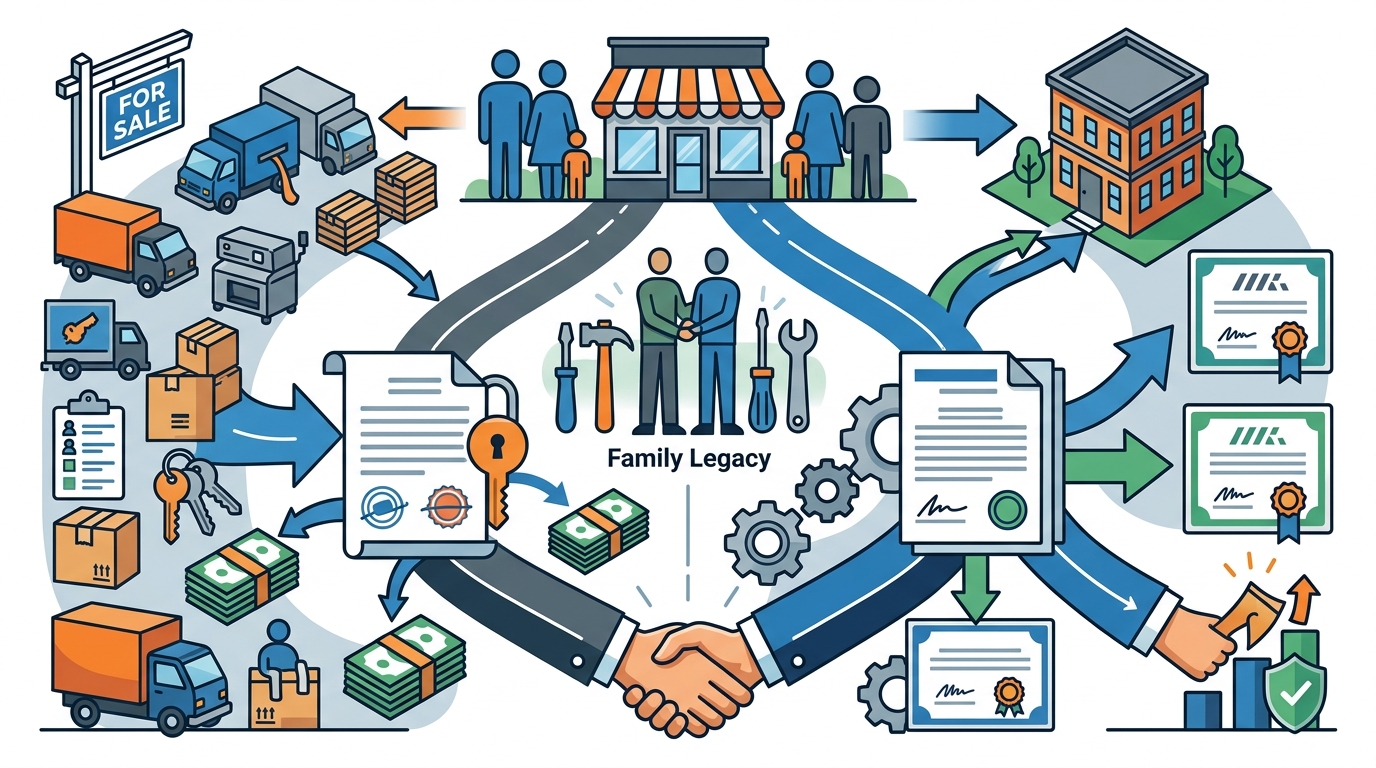
An asset sale occurs when the business entity sells specific assets to a buyer. The buyer typically picks and chooses which items they want, such as equipment, inventory, customer lists, and intellectual property. The seller retains the corporate shell and any liabilities not explicitly assumed by the buyer.
Buyer Preference and Liability Shield
Buyers often prefer asset sales because they can step up the basis of the purchased assets for tax depreciation purposes. More importantly, they can avoid inheriting hidden liabilities, such as pending lawsuits or environmental issues. This structure provides a clean break for the buyer, which can be a significant negotiating point.
Seller Risks and Double Taxation
For the seller, asset sales can be less attractive due to potential double taxation. If the business is a C-Corporation, the corporation pays tax on the gain from the asset sale. Then, when the proceeds are distributed to shareholders, they pay personal income tax on the dividend. This is why many family businesses consider the structural implications early in the process.
Additionally, the seller must manage the wind-down of the corporate entity. This involves dealing with creditors, handling remaining liabilities, and dissolving the business formally. It is a complex administrative burden that requires precise legal oversight.
The Case for Equity Sales
In an equity sale, the buyer purchases the ownership interests of the company, such as shares of stock or membership units. The business entity itself remains intact, continuing to own its assets and assume its liabilities. The change is in who controls the entity, not what the entity owns.
Continuity and Simplicity
Equity sales are often simpler to execute because the business continues its operations without interruption. Contracts, licenses, and permits remain in the company's name, avoiding the need for third-party consents that often accompany asset transfers. This continuity can be vital for businesses with long-term service agreements or regulated operations.
Tax Advantages for Sellers
Sellers frequently favor equity sales for their tax efficiency. The gain is typically treated as a capital gain at the shareholder level, avoiding the double taxation associated with C-Corporation asset sales. For LLCs, which are pass-through entities, the tax treatment is generally straightforward, with gains flowing directly to the owners' personal tax returns.
However, buyers may resist this structure due to the assumption of historical liabilities. To mitigate this, buyers often require extensive representations and warranties, as well as indemnification clauses, to protect themselves from pre-closing issues.
Key Differences at a Glance
Understanding the mechanical differences between these two structures is essential for informed decision-making. The table below summarizes the core distinctions.
| Factor | Asset Sale | Equity Sale |
|---|---|---|
| Liability Assumption | Buyer typically avoids unknown liabilities. | Buyer assumes all known and unknown liabilities. |
| Tax Treatment | Potential double taxation for C-Corps. | Capital gains treatment for shareholders. |
| Asset Step-Up | Buyer gets a step-up in basis. | No step-up in basis for assets. |
| Complexity | Higher due to asset transfers and consents. | Lower due to entity continuity. |
| Vendor Preference | Often less preferred due to tax impact. | Often preferred for tax efficiency. |
Tax Implications and Strategy
Tax planning is the cornerstone of any successful exit. The choice between asset and equity sales can dramatically alter the net proceeds the family receives. For instance, the recent changes in SBA regulations regarding small business acquisitions have introduced new nuances for financing these deals. Understanding how these rules apply to your specific structure is crucial.
Our firm stays ahead of regulatory changes to provide timely advice. For example, we monitor updates to hospitality and liquor licensing laws, which can impact the value of certain business assets during a sale. Similarly, we track real estate law updates that affect property-heavy businesses.
We also advise on intellectual property protection during transitions. Ensuring that trademarks and patents are properly assigned or retained is a critical step that often gets overlooked in the excitement of closing a deal.
Frequently Asked Questions
What is the primary difference between an asset sale and an equity sale?
An asset sale involves the transfer of specific business assets, while an equity sale involves the transfer of ownership shares in the company. The key distinction lies in how liabilities and taxes are handled.
Which structure is better for tax purposes?
It depends on the entity type. Equity sales often offer capital gains treatment for sellers, avoiding double taxation. Asset sales may allow buyers to step up the basis of assets, which can be a negotiating lever.
Can a family business use a mix of both structures?
Yes, hybrid structures are possible. For example, a seller might sell assets but retain certain liabilities or intellectual property. This requires careful drafting to ensure clarity and legal compliance.
How do liabilities affect the choice of structure?
Buyers often prefer asset sales to avoid inheriting unknown liabilities. Sellers may prefer equity sales to avoid the complexity of transferring individual assets and dealing with creditors.
What role does the corporate entity play in an equity sale?
In an equity sale, the corporate entity remains intact. It continues to hold assets, contracts, and licenses. The change is solely in the ownership of the shares or units.
Are there industry-specific considerations for family business exits?
Yes. Industries like hospitality and real estate have unique regulatory requirements. For example, liquor licenses or property leases may require third-party consents for transfer, impacting the feasibility of an asset sale.
How long does the exit process typically take?
The timeline varies based on complexity, due diligence, and regulatory approvals. A straightforward equity sale might close in a few months, while a complex asset sale with multiple consents could take longer.
Next Steps for Your Exit
Planning your family business exit requires more than just financial modeling. It demands a strategic legal framework that protects your legacy and maximizes your returns. Warren Kalyan provides the integrated legal and business partnership needed to navigate this complex landscape.
We help clients think through issues, synthesize strategies, and stand alongside them as a true legal and business partner. Our approach is rooted in value, efficiency, and effectiveness. Whether you are structuring a new entity, closing an acquisition, or executing a sale, we move swiftly and effectively.
Do not leave your family's future to chance. Schedule a time to chat with our team today. Let us help you execute your exit strategy with confidence and precision.