

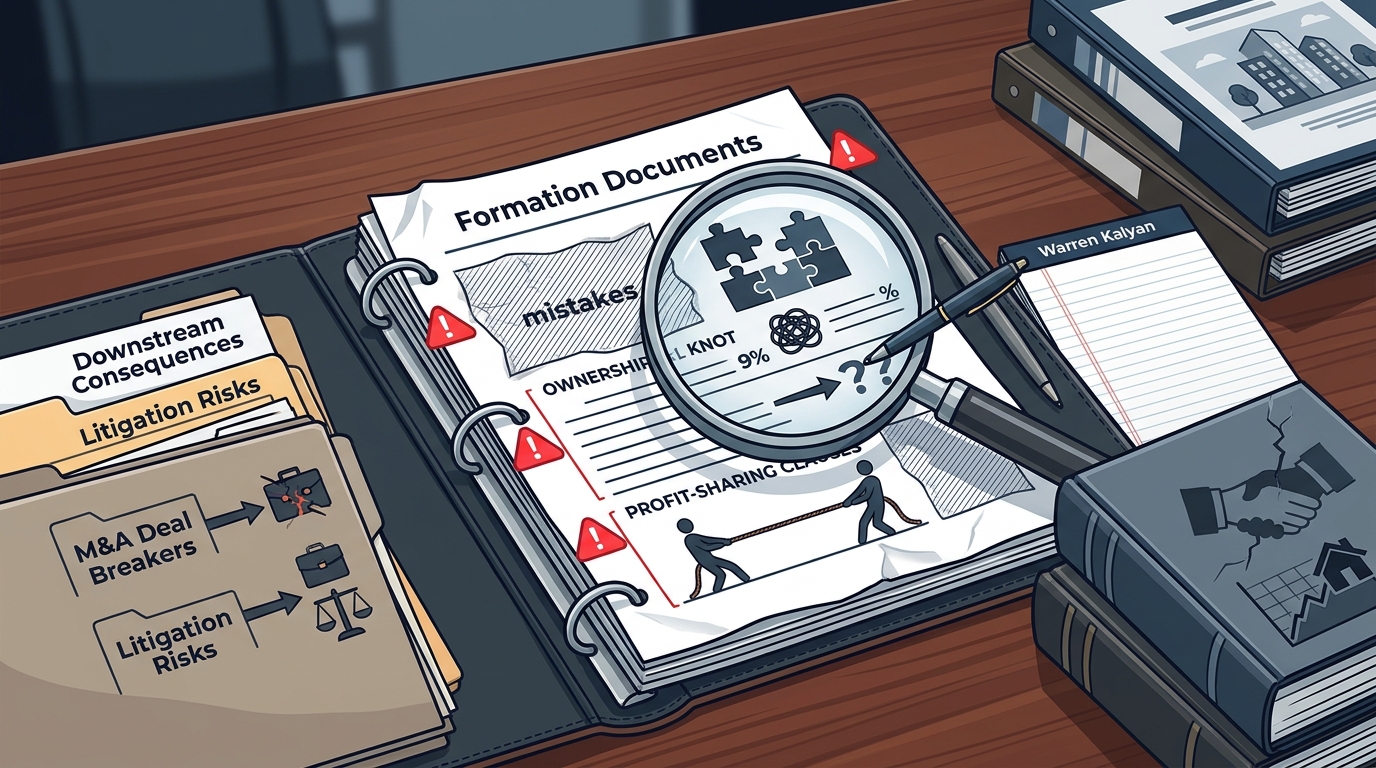
Formation documents officially create your business entity and define the rules of engagement between owners. When these foundational files are drafted with ambiguity or omissions, they create the exact legal vacuum where partnership disputes and business breakups take root. At Warren Kalyan, we see the downstream consequences of these early drafting errors every day in our litigation and M&A practices. This listicle identifies the seven most common formation document mistakes that fracture ownership structures and lead to costly, protracted legal battles.
1. Vague Profit and Loss Allocation Terms
Unclear financial distribution rules are the single most common catalyst for immediate owner conflict. Many founders assume that a 50/50 ownership split automatically means a 50/50 split of profits, but the operating agreement or articles of incorporation must explicitly state how cash flow is distributed. If the document fails to distinguish between distributable cash flow and retained earnings, owners will inevitably disagree on what constitutes a payout. This ambiguity forces partners into a standoff over the company's treasury, often requiring a court to interpret the founders' original intent years later.
2. Missing Buy-Sell or Right of First Refusal Clauses
Without a mechanism to handle the transfer of ownership, a single departing partner can destabilize the entire enterprise. A buy-sell agreement is a contractual provision that dictates what happens when an owner wants to leave, dies, or becomes incapacitated. If this clause is absent, a disgruntled member can sell their equity to a competitor or an outside investor without the consent of the remaining partners. This lack of control over who holds the equity is a primary driver of forced breakups and hostile takeovers in closely held companies.
3. Undefined Management and Voting Thresholds
Failure to specify who makes decisions and how many votes are required creates a permanent governance gridlock. The formation document must clearly delineate whether the business is member-managed or manager-managed. It must also define the voting thresholds for major corporate actions, such as selling the business, taking on significant debt, or admitting new members. When these thresholds are left to statutory defaults or are vaguely described, routine business decisions can become deadlocked, paralyzing operations and forcing a judicial dissolution.
4. Inadequate Deadlock Resolution Mechanisms
5. Ambiguous Capital Contribution and Funding Obligations
Unclear rules for additional capital calls create resentment and cash flow crises during growth phases. The initial formation documents often specify the starting capital contribution, but they frequently fail to address what happens when the business needs more money. If the document does not specify whether owners are required to make additional contributions or if they can simply dilute their ownership percentage, it sets the stage for a dispute over who bears the financial burden of growth. This is a critical oversight for startups and real estate ventures that require ongoing capital injection.
6. Overly Broad or Missing Non-Compete Provisions
Failure to restrict owners from competing with the business allows a departing partner to take clients and trade secrets to a rival. A non-compete clause is a contractual restriction that prevents a former owner from starting a competing business within a certain geographic area and time frame. If this provision is missing or drafted too narrowly, a partner can leave the company and immediately open a competing venture across the street. This directly undermines the value of the remaining owners' investment and is a frequent subject of breach of fiduciary duty claims.
7. Ignoring State-Specific Filing and Compliance Requirements
Technical filing errors or failure to maintain good standing can invalidate the entity's liability protection. Many states require a supplemental report shortly after formation that updates the state on the LLC's current leadership and address, as noted by legal clarity resources. If the formation documents are not properly filed or if the registered agent information becomes outdated, the state can administratively dissolve the entity. This technical failure can strip owners of their limited liability protection, exposing their personal assets to business debts and triggering immediate disputes over who is responsible for the compliance lapse.
Choosing the Right Formation Strategy
The best way to avoid these mistakes is to treat your formation documents as a living business plan rather than a bureaucratic formality. When choosing between a simple template and a custom-drafted agreement, consider the complexity of your ownership structure and the long-term goals of the business. For multi-member entities, real estate ventures, or companies with significant capital, a custom agreement is essential to protect your equity and control. At Warren Kalyan, we specialize in corporate planning and structuring, ensuring that your formation documents are aligned with your operational goals and designed to prevent disputes before they start.
Frequently Asked Questions
What is the most common mistake in LLC operating agreements?
The most common mistake is failing to define the process for transferring ownership interests. Without a clear right of first refusal or buy-sell provision, a member can sell their stake to an outsider, disrupting the partnership and potentially introducing a competitor into the company.
Do I need a lawyer to draft my formation documents?
While you can file basic formation documents with the state, it is highly recommended to use a lawyer to draft the internal operating agreement or bylaws. These internal documents contain the complex rules for profit distribution, management, and dispute resolution that are not covered by the simple state filing.
Can I fix formation document mistakes after the business is formed?
Yes, you can amend your operating agreement or articles of incorporation. However, amending these documents requires the consent of the owners, which can be difficult to obtain if a dispute has already arisen. It is much easier and cheaper to get the documents right the first time.
What happens if my formation documents are silent on a specific issue?
If the formation documents are silent, the default rules of the state's business code will apply. These default rules are often generic and may not reflect the specific intentions of the founders, leading to unexpected outcomes and potential disputes.
How does Warren Kalyan help with formation documents?
Warren Kalyan provides comprehensive corporate planning and structuring services. We draft custom formation documents that address profit allocation, management rights, and dispute resolution mechanisms, ensuring your business is legally protected from the day it is formed.